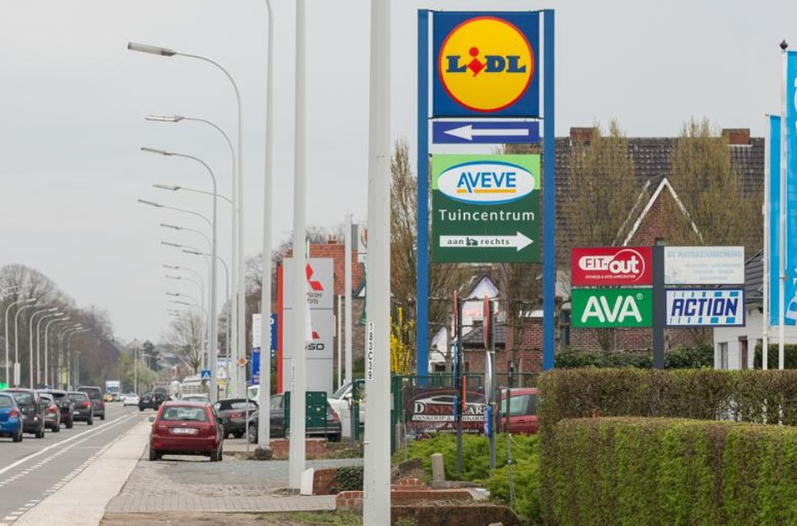
The Flemish government aims to give cities and municipalities more leverage to ‘cluster’ retailers. To that end, the Decree of 15 July 2016 on Integrated Retail Establishment Policy provides that for a store with more than 400 m² net retail floor area, a (socio-economic) file must be added to the environmental permit application. That file must set out the store assortment on the basis of 4 categories.
The government assesses the (socio-economic) file against the objectives laid down in the Decree of 15 July 2016 on Integrated Retail Establishment Policy, namely:
1° creating sustainable establishment opportunities for retail, including avoiding undesirable retail ribbons;
2° guaranteeing an accessible offer for consumers;
3° guaranteeing and strengthening liveability in the urban environment, including strengthening core shopping areas;
4° achieving sustainable mobility.
Practical experience showed that in permit applications, among other things, the residual category 4 ‘Other products’ was interpreted too broadly. This category covers stores with very different visitor frequencies and mobility effects, which did not benefit complementarity with the shopping cores. The original Decree on Integrated Retail Establishment Policy was therefore revised.
The Decree of 7 July 2023 accordingly amended the Decree of 15 July 2016 on Integrated Retail Establishment Policy and the Decree of 25 April 2014 on the environmental permit, as regards the permit requirement for retail activities.
On 12 January 2024, the Flemish Government set the date of entry into force of articles 4 and 6 of this amending decree at 4 March 2024.
What is new (main changes)?
🪚Not 4 but 6 categories (article 4):
Up to and including 3 March 2024, there are 4 categories of retail activities; from 4 March 2024, there will be 6. The new categories are:
1° sale of food;
2° sale of personal equipment;
3° sale of plants, flowers and goods for agriculture and horticulture;
4° sale of vehicles and means of transport;
5° sale of bulky goods not covered by the categories in points 1° to 4°;
6° sale of non-bulky goods not covered by the categories in points 1° to 4°.
Bulky goods are defined as goods whose height, width and depth add up to at least 2.5 metres. Examples of bulky goods are (medium-)large furniture and electrical appliances (TVs, fridges, …), windows and doors, stairs, but also large boards and panels and other larger building materials.
A transitional arrangement was provided for retailers who obtained a permit under category 4 ‘Other products’. No new permit needs to be applied for as long as the assortment does not change substantially. Their offer is, however, automatically assigned by law to the new categories.
🪪(Additional) permit requirement (article 6):
An additional permit requirement is introduced for splitting up larger retail areas (more than 400 m² net retail floor area). The legislator’s view (after advice from, among others, VLAIO) is that such splits have a significant impact on mobility generation and on complementarity with the town centre.
A number of specific retail activities will be excluded from the permit requirement, namely pharmacies, petrol stations and electric charging stations, and auction houses.
The following changes are also planned, but their entry into force is still pending:
🏬Refinement of a number of definitions:
The definitions of retail business and retail complex are amended.
A retail business is described as a business where goods can be sold to the consumer not only fully but also partly. Think of wholesalers, mixed stores where not only goods are sold but a restaurant or bar is also operated, …
A retail complex is now described as a group of retail businesses within the same building or in adjoining buildings for which the environmental permit for urban development works was obtained jointly, regardless of whether:
a) the retail businesses are located on one plot or on adjoining plots;
b) the same person is the developer, owner or operator of the retail businesses.
A retail complex can thus take various forms: a traditional shopping centre, the ground floor of an apartment building with several retail units, several retail units on a large project site, …
👮♂️Additional enforcement options:
In addition to the police zone, the municipality or an intermunicipal association, at the request of the municipality, will also be able to enforce environmental permits for retail. This gives the municipality more options to intervene in the event of breaches of the permit requirement or permit conditions.
In any case, the application forms W1 (retail activities) and E1ter (retail mobility assessment) for the environmental permit for retail activities have been adapted on the basis of the amending decree.
What does this mean for your project?
Ask your question